Wednesday, August 26, 2009

Functions of the Retail Forex Market

Retail Forex market became very popular after the development of the on-line trading technologies. Millions of new traders are attracted to Forex each year. They try to earn profits trading the currencies, developing the new intraday strategies and gaining on the long-term trends. But why does the retail FX market exist? Is it only a way to earn money for the brokers and some lucky traders? Here is the list of some functions — obvious and not — that are performed by the retail Forex market:

  1. Earning opportunity — this is probably the most popular, obvious and important function of the retail Forex market. It provides the earning opportunity to traders, brokers, affiliates, webmasters, marketing companies and a lot of other on-line industries. Without a promise of profits retail Forex market would be limited to a simple exchange of the physical or current-account money.
  2. Extra liquidity — this is definitely a positive function of the retail currency market. Although, not many traders use huge amounts of cash on Forex, the total sum of the money provided by the retail customers adds a good chunk of liquidity to the Forex market.
  3. Extra volatility — a not very positive function at a first glance. Retail Forex market makes the rate movement less smooth and more volatile as the traders prefer short-term trading, which leads to the sharp reactions on the daily news and technical signals. Excess volatility is bad for the long-term traders, but it can be good for those who know how to benefit from such markets.
  4. Social function — many communities were formed around the Forex trading. Traders prefer to get help from other traders and they also like to share the knowledge that is related to Forex.
  5. Technical strategy development — popularity of the Forex trading and especially the on-line and automated versions of this trading led to the creation of thousands of the automated trading strategies. Based on technical analysis some of such strategies can be applied not only in Forex trading but in many other industries.
Of course, this list can't be considered as full and complete, but these functions are the main attributes of the contemporary retail Forex market, in my opinion.

Saturday, August 22, 2009

Origin of the Currency Exchange Market

Forex trading has a pretty long history and could be seen in ancient Middle Ages when foreign exchange just started out as international merchant bankers devised bills of exchange, which could be transfered to third-party payments that allowed flexibility and growth in foreign exchange dealings.

The modern FX market is is variable with periods of high volatility and relative stability . By the mid-1930s, London became known as the leading center for foreign exchange and the British pound served as the benchmark currency to trade and was kept as reserve currency.

After the 2nd World War, when the British economy was decimated and the United States was the only country unscathed by war, U.S. dollar ($) became the reserve currency for most of the countries . In turn, the U.S. dollar was pegged to gold at $35 per ounce. Thus, the U.S. dollar became the world's reserve currency.

To execute these goals the IMF uses such instruments as Reserve trenches, which allows a member to draw on its own reserve asset quota at the time of payment, Credit trenches drawings and stand-by arrangements. The letters are the standard form of IMF loans unlike of those as the compensatory financing facility extends financial help to countries with temporary problems generated by reductions in export revenues, the buffer stock financing facility which is geared toward assisting the stocking up on primary commodities in order to ensure price stability in a specific commodity and the extended facility designed to assist members with financial problems in amounts or for periods exceeding the scope of the other facilities.

At the end of the 70-s the free-floating of currencies was officially mandated that became the most important landmark in the history of financial markets in the XX century lead to the formation of Forex in the contemporary understanding. That is the currency may be traded by anybody and its value is a function of the current supply and demand forces in the market, and there are no specific intervention points that have to be observed. Foreign exchange has experienced spectacular growth in volume ever since currencies were allowed to float freely against each other. While the daily turnover in 1977 was U.S. $5 billion, it increased to U.S. $600 billion in 1987, reached the U.S. $1 trillion mark in September 1992, and stabilized at around $1.5 trillion by the year 2000.

Main factors influences on this spectacular growth in volume are mentioned below. A significant role belonged to the increased volatility of currencies rates, growing mutual influence of different economies on bank-rates established by central banks, which affect essentially currencies exchange rates, more intense competition on goods markets and, at the same time, amalgamation of the corporations of different countries, technological revolution in the sphere of the currencies trading. The latter exposed in the development of automated dealing systems and the transition to the currency trading by means of the Internet. In addition to the dealing systems, matching systems simultaneously connect all traders around the world, electronically duplicating the brokers' market.

Advances in technology, computer software, and telecommunications and increased experience have increased the level of traders' sophistication, their ability to both generate profits and properly handle the exchange risks. Therefore, trading sophistication led toward volume increase.

Thursday, August 13, 2009

Variety of Forex Scams

Apart from being potentially profitable, Forex market becomes more dangerous nowadays. There many scams in the Forex industry and they vary in types and scales. If you want to start trading Forex you should know a lot about such scams to avoid losing your hard-earned money. And if you are the experienced Forex trader you’ve probably already got hurt from some Forex scam and if not — you should also know about Forex scams to avoid them in the future.

  • Forex broker scam. It was very popular several years ago, but its popularity seems to fade now. Usually it’s just some set-up Forex broker site that promises the good trading conditions and offers some basic «bucket-shop» trading simulation to attract large customer base and run away with their money. Just do your research on a broker before depositing money and you’ll be safe from such scams.
  • Forex strategies selling. There are hundreds «successful» Forextrading strategies selling on the Internet. Many traders tend to believe that they can spend $300 on such a strategy and become rich with it. In reality the best thing that money can buy is education. Sold strategies are usually nothing but crap. Not only they won’t make you rich, they will probably make you lose your account margin.
  • Forex e-books selling. Overrated and hyped e-books with a lot of marketing and a little use (if at all) are the actual problem of many industries. Forex e-books selling for ridiculously high prices and promising to tell you «the best kept secrets of the millionaire traders» are nothing but wasted money. You’d better lose that money in Forex trading, trying to find your own strategy and getting some real practice.
  • Scam Forex managed accounts. Some people like the idea of Forex, but don’t like to trade on this market, they prefer to invest in it. That’s where managed accounts come to play. It’s a good idea to have some company or a private trade to trade for you and earn a share of profit. But unfortunately there also scam players here. They will just take your money and disappear. Some scam managers will probably even pretend that they are really trading and will show you some profit, hoping that you’ll deposit more. Don’t fall for such scams, thoroughly research your manager or better invest in some reputable managing company.

Reacting on Forex News

Trading on the Forex news is a popular strategy that is generally adopted among both professional and barely experienced traders. Apart from the standard high volatility accompanying important economic releases,Forex traders try to earn by predicting the outcome of the news, successfully forecasting the market’s reaction. However there are three important points every news trader should know before reacting on theForex news:

      • Generally it’s a good idea to set the entry orders before the actual news release. Use stop and limit orders to make the entry to trigger automatically and at the desired levels even on a very volatile market.
      • Setting stop and limit orders for entry is a good way to automate the news trading, but it’s also a good idea to stay near your trading platform during the news release. Sometimes the market demands your personal reaction and your own understanding of the current situation to bring you profits and save you from losses.
      • You should know beforehand if your broker allows news trading. ManyForex brokers forbid trading during the news of the high importance tothe Forex market. They can do it either via their terms of service or via some technical obstacles. Some brokers widen their spreads to extreme values during the news, while the others just stop reacting to the trader’s orders. Don’t even try earning from the news trading if your broker doesn’t allow it.Don’t be scared to trade on the Forex news. It’s a good tactic for every kind of trader and will work on the most Forex brokers. Just try to avoid the common mistakes associated with this trading strategy.

Tuesday, August 11, 2009

A Few Tips For Day Trading the Stock Market


Day trading the stock market involves the rapid buying and selling of stocks on a day-to-day basis. This technique is used to secure quick profits from the constant changes in stock values, minute to minute, second to second. It is rare that a day trader will remain in a trade over the course of a night into the next day. These trades are entered and exited in a matter of minutes.

The main question that most people ask when it comes to day trading is simple: Is it necessary to sit at a computer watching the markets ALL day long in order to be a successful day trader?

The answer is no. It's not necessary to sit at a computer all day long. There are a number of factors to consider, but generally the rule of day trading is to trade when everyone else is trading. In other words, trade in the morning.

As with all financial investments, day trading is risky � in fact, it's one of the riskiest forms of trading out there. The stock prices rise or fall according to the behavior of the market, which is entirely unpredictable. Day traders buy and sell shares rapidly in the hopes of gaining profits within the minutes and seconds they own those particular stocks. Simple to do in theory, harder to do in practice.

If you are constrained by a small amount of capital, you may not be able to buy large amounts of a stock, but buying only a small amount can add to the risk of a loss. And, obviously, it is impossible to predict with certainty which stocks will result in profits and which in losses. Even the best of traders must learn to accept both outcomes.

It's also important to know that in day trading, it is the number of shares rather than the value of shares that should be the focus. If you day trade, you WILL face losses, but even for the more expensive stocks, the loss should be marginal, because prices do not usually fluctuate to an extreme degree over the course of just one day.

The day trading industry deals in a large variety of stocks and shares. Here are just a few:

Growth-Buying Shares� shares made from profit, which continue to grow in value. Eventually, these shares will begin to decline in price, and an experienced trader can usually predict the future of this type of share.

Small Caps� shares of companies which are on the rise and show no signs of stopping. Although these shares are generally cheap, they are a very risky investment for day traders. You'll be safer to go with large caps and/or mid-caps, which are much more secure and stable thanks to a premium.

Unloved Stocks company stock that has not performed well in the past. Traders buy these shares in the hopes of generating profits if and when the stock rises in value. As with small caps, unloved stocks can be a risky choice for day traders.

These examples are NOT your only options when it comes to day tradingstocks. The best way to determine which type of stock is right for you is to invest some time for careful research, a knowledge of market patterns, a solid strategy, and a disciplined trading plan.

The key to successful day trading is to be prepared. Know as much as possible about the industry before you begin actually trading. You need to learn to trade ONLY when the market gives the right signals, and ONLY when the volume of activity in the market supports a successful trading opportunity.

Monday, August 10, 2009

Disadvantages of the Automated Forex Trading

In my I’ve described the best advantages of the automated Forex trading. But, of course, I understand that the trading using the expert advisors isn’t always something good. Everything has its own pros and cons; so the automated trading has its own disadvantages and I’ll try to describe them in this article:
No intuition to help your trading. Computers and programs simply don’t have anything similar to that mystical human feeling. While some traders don’t think that the intuition can be helpful in trading, others rely on it — such traders probably won’t be pleased with the automated trading.Smooth trade execution and uninterrupted run-time of the expertadvisors is critical with many trading systems. Unfortunately, it’s something very hard to achieve running EA from your home or work PC. That means that you’d require some dedicated server to run yourautomated trading.Some types of strategies are simply impossible to implement into the real expert advisors. The chart pattern or wave analysis and fundamental analysis are extremely hard to code in the trading program. At the current level of the AI development these tasks are better performed by he live trader manually.The expert advisors should be made quality or otherwise their trading results will disappoint you. Unfortunately, not all expert advisors handle errors and other unexpected events correctly — sometimes this can lead to the huge losses. Moving your working EA from one broker to another can also be a problem, since broker servers differ and what works perfectly on one broker can stop working on another.
As you see, nothing is perfect in this world and, while being the extremely interesting and popular tool, automated Forex trading has its own problems. The wise decision here, in my opinion, would be using both types of trading to your advantage. The systems that can be easily implemented as the expert advisor and are too hard to be traded manually are better to be automated, while the simple systems that involve chart pattern and fundamental analysis are better left for the manual trading.

Sunday, August 9, 2009

Forex Weekly Trading Forecast - 08.10.09

Does the Dollar's NFP Rally Have Staying Power?

Fundamental Outlook for US Dollar: Bullish

- Payrolls drop the least in 11 months and the jobless rate ticks lower for the first time since April of 2008
- Person spending contrasts at its fastest pace in four-and-a-half years, jeopardizing spending and a recovery
- The dollar pulls itself back from wide-spread bearish break, but is this a true reversal?

The dollar was on track to plummet to new lows for the year at the start of last week; but what a difference one indicator and a few hours’ worth of speculative-heavy price action can have. Last Monday, made the bearish break that the battered currency had been flirting with for weeks. However, this break was not catalyzed by any specific fundamental driver; nor was it supported by a meaningful trend in risk appetite. Without the necessary fuel to push the dollar to new lows, it would instead stall on the other side of its key technical level for a genuine fundamental driver to reverse the currencies fortunes and potentially completely change its future. On the other hand, this fledgling rally could prove to be just as feeble as the previous plunge should an underlying fundamental driver not step in and take control. Among the reasonable drivers for a true bull trend, either the dollar will have to break its ties to investor sentiment (as a safe haven currency) or risk appetite will have to collapse.

Analyzing the initial surge that put the greenback into such a compromising position for the weekend, it was clear that this rally was defying gravity as capital markets were following the same path. The Dow Jones Industrial Average tested fresh nine-month highs and the 10-year Treasury note marked its worst performance since the early June reversal. As a well-known safe haven or funding currency, the currency typically exhibits a tight, negative correlation to these financial market counterparts. Under normal circumstances, we would expect this natural relationship to return. Taking stock of risk appetite, there are very few scheduled events over the first half of the week that could carry optimism (or turn it for that matter). Later in the week, we will have the first readings on European growth, official policy statements (the BoE Quarterly Monetary Policy Report and RBA Governor’s semi-annual testimony) and the a couple rate decision. These events have the clout to alter expectations for global growth and yields; but if momentum builds through speculation before these fundamentals are absorbed, the market could write it off.

There is another means for the dollar to maintain its bullish projection; but it would be far more difficult to muster. If the world’s reserve currency was able to shake its label as the primary safe haven; it could rise on the merits of its own economic performance. While we have been trending toward this state for some time, it has been very slow. A rapid shift would be difficult to accomplish because of the currency’s place in the world’s financial markets, the prevalence of its Treasuries, the ballooning budget deficit, the fact that it is considered the source of the worst financial crisis since WWII and the very fact that it is used as a benchmark. Nonetheless, data and speculation put this indicator high up on the scale of economic recovery. While the US certainly isn’t enjoying the pace of expansion of its Chinese counterpart; the pace and extent of its recovery are expected to beat the UK, Japan and the Euro Zone (which we will confirm with next week’s GDP numbers). Friday’s non-farm payrolls certainly bolstered this belief after the disappointing details of the 2Q GDP report. Next week’s data will certainly weigh in on this front. A confidence and retail sales report will cover consumer spending which accounts for approximately 70 percent of the economy. The trade report will fill in for global demand and the capital flows it is adds or detracts.

Realistically, the growth aspect of the dollar outlook is very long-term. Perhaps a new, more meaningful focus will actually fall to the Fed. It has been subtle; but over the past few months, there has been a steady pick up in speculation for a hawkish rate regime to return well before Chairman Bernanke has accounted for (he has previously suggested the middle of next year). According to Fed Fund futures, there is a 40 percent probability of a hike by December. The FOMC rate decision and CPI data will bear on the rationality to such musings.

Euro May See Further Declines Ahead of Euro-zone Q2 GDP, CPI

Fundamental Forecast for Euro: Bearish

- Euro-zone manufacturing PMI was revised up to a 1-year high
- Euro-zone services PMI continued to signal a contraction in activity, albeit at a slower pace
- The European Central Bank struck a neutral tone, left rates unchanged at 1.00%

The euro was one of the weakest major currencies on Friday, but it has little to do with European data. Instead, the release of US non-farm payrolls triggered a surge in the US dollar, which led EURUSD to break out of a tight range and down roughly 200 points. Looking at things from a macro perspective, the US employment numbers have led the markets to price in a greater probability of rate hikes by the Federal Reserve down the line, while the neutral tone struck by the European Central Bank on Thursday has left the euro dead in the water. That said, while 1.4150 offered support for EURUSD on Friday, more substantial support may not come into play until 1.4080, where we have the 50 SMA and a rising trendline connecting the April and July lows.

In the coming week, as the euro will face very high event risk from the release of Q2 GDP. The advanced reading of Q2 GDP is forecasted to contract for the fifth straight quarter, this time at a rate of -0.5 percent, compared to -2.5 percent in Q1, while the year-over-year rate could fall by a record 5.1 percent. Such data would back up the ECB’s recent claims that the pace of contraction is “clearly slowing,” and if GDP falls less than anticipated, the euro could rally. On the other hand, a worse-than-expected decline in Q2 GDP could weigh on the currency.

There will also be a handful of other indicators released throughout the week. On Wednesday, Euro-zone industrial production is projected to rise slightly for the month of June, but after the German results reflected a small drop, there are downside risks for the broader release. Meanwhile, the European Central Bank’s monthly report is unlikely to expand upon what ECB President Jean-Claude Trichet said in his policy statement last Thursday. Indeed, as far as ECB releases go, their next decision on September 3 will be the major one to watch as they will revise their economic forecasts. Finally, on Friday, Euro-zone CPI growth is projected to remain at -0.6 percent for the month of July from a year earlier, as the ECB does not anticipate that annual inflation rates will turn positive again until “later this year.” Nevertheless, lower than expected results could stir up concerns that deflation is a major risk for the Euro-zone economy.

Japanese Yen Vulnerable if Economics Overtake Risk as Market Catalyst

Fundamental Forecast for Japanese Yen: Bearish

- Japanese Workers’ Earnings Fell The Most in Over 18 Years
- US Non-farm Payrolls Report Sends Japanese Yen Lower

The Japanese Yen looks set for sharp declines as economic fundamentals look set to re-capture the attention of the currency markets. The credit crises and subsequent global recession that erupted last year had introduced a new dynamic to financial markets, with virtually all asset classes locking into tight correlations on opposite sides of a directional bet on the direction of risk appetite. At times of risk aversion, this meant a stronger US Dollar and Japanese Yen; at times when traders less timid, this meant higher stocks, commodities and high-yielding currencies. Last week may go down in history as the key turning point when the market began to transition back from this “crisis dynamic” to more normal, macroeconomics-driven trading.

Currency markets seemed strangely complacent in the first week of August, showing next to no follow-though as five-month long rally in risky assets raced past major swing highs in the last days of July. Traders’ response to July’s better-than-expected US jobs report was a firm departure from crisis-induced patterns: stocks, carry trades, and the US Dollar all rallied while the Japanese Yen collapsed. The decoupling between the US Dollar and the Yen is most notable: we had long argued that the long-term US Dollar outlook would remain bullish after risk aversion faded on expectations that the States will be first to recover from recession having led the way into it, and this is precisely what post-NFP price action seems to have reflected.

The implications of fundamentals-driven price action spell trouble for the Japanese Yen. Median GDP forecasts from economists polled by Bloomberg suggest Japan will under-perform virtually every major industrial economy with the exception of the Euro Zone in 2009 and 2010. Consequently, interest rates are to remain at near-zero levels at least until 2011 even as most central banks begin to reverse course from extremely accommodative monetary policy in the second half of next year. This stands to inject a lot of life into the carry trade, with Yen remaining as the standby funding currency. While the global recovery is sure to be sluggish and there is little doubt that equity markets are overvalued having finished July at the highest level relative to earnings since October 2003, the Yen may be at the cusp of a major long term down trend.

Turning to next week’s economic calendar, the number of scheduled release is ample but none of them are likely to prove particularly market-moving. A larger current account surplus in June has been amply telegraphed by merchandise trade balance figures released two weeks ago. The Bank of Japan rate decision will surely prove to be a non-event considering policymakers have largely run out of policy levers that can be pulled and so are in a de-facto “wait and see” mode. Indeed, there is nowhere left to go on interest rates and broad-based quantitative easing has already been extended into 2010. A handful of sentiment surveys and June’s Tertiary index of service demand are unlikely to offer anything that is surprising enough to warrant meaningful exchange rate volatility.

British Pound Outlook Suffers on BoE Surprise – Can FOMC Do Same?

Fundamental Forecast for British Pound: Neutral

- British Pound Dives as Bank of England Boosts Quantitative Easing
- Higher Producer Prices report fails to lift GBPUSD
- View our Monthly British Pound Exchange Rate Forecast

The British Pound finished the week nearly unchanged against the resurgent US Dollar, as an impressive GBP rally gave way to a sharp reversal on surprise Bank of England announcements. BoE officials took markets by surprise in announcing an expansion to their Quantitative Easing measures, boosting the total size of their asset purchase program by a further £50 billion to £175 billion. Forex traders instantly showed their displeasure with the announcement and sent the GBPUSD over 200 pips lower in the short moments following the release. Few were willing to subsequently buy into the GBP declines, and indeed the suddenly-downtrodden currency pair fell even further on to finish the week’s trade. Short-term GBPUSD momentum points to further losses, but it will be important to monitor financial market follow-through and key UK and US economic event risk.

The combination of surprise Bank of England announcements and a data-driven US Dollar reversal meant that the GBPUSD finished lower despite sharp equity market rallies. Yet the medium-term correlation between the Sterling/US Dollar exchange rate and the UK FTSE 100 index continues to trade near record-highs, and we suspect that financial market risk sentiment will resume driving both the Pound and the US Dollar in the days ahead. Financial markets will look to upcoming UK housing and labor market data with particular interest, while a US Federal Open Market Committee rate decision looms large over all US Dollar pairs.

Recent UK economic data has broadly shown relative improvement in domestic activity and said trend will be put to the test by upcoming Jobless Claims results. Consensus forecasts call for a 28.0k increase in Jobless insurance claims and a marginal increase to the national jobless rate at 4.9 percent. The result would represent the worst unemployment since 1997, but as recent market reaction to US Nonfarm Payrolls data clearly shows, financial markets are mostly interested in the rate of deterioration. The S&P 500 surged on news that the US economy lost “only” 247k jobs in the month of July, and we would expect similar reactions out of the FTSE 100 on a better-than-expected UK Jobless Claims release. Impressive PMI survey data suggests that risks remain to the positive side for the report, but Jobless numbers are notoriously difficult to predict.

It otherwise remains important for British Pound traders to watch for market reaction to the US FOMC interest rate announcement due Wednesday. The US Fed is very widely expected to leave its short-term interest rate unchanged in its upcoming meeting, but that hardly rules out post-announcement volatility. Indeed, the same was sad for the past week’s Bank of England rate decision and we remain keenly aware that any surprise shifts in rhetoric could force substantial FX market moves. Recent US economic data has shown general improvements in domestic activity, but the same could have been said for the UK. With that in mind, we will keep a close eye on the FOMC announcement and its effects on broader financial markets.

The British Pound’s aggressive reversal leaves scope for further pullback, and the coming week of price action could be “make or break” for the previously high-flying GBPUSD.


Written by John Kicklighter, David Rodriguez, Terri Belkas, Ilya Spivak and John Rivera, Currency Analysts
Article Source - Forex Weekly Trading Forecast - 08.10.09

U.S Non-Farm employment Change Set to Determine USD Volatility

The U.S. Dollar is expected to go extremely volatile today on the release of the ever so important U.S. Non-Farm Employment Change at 12:30 GMT. The other releases that are expected to drive trading between the USD and its main crosses today are the British PPI Input at 08:30 GMT, the U.S. Unemployment Rate at 12:30 GMT, and the Canadian Unemployment Rate at 11:00 GMT. Forex traders are advised to open their USD positions now, prior to the release of the vital economic data from the leading economies.


USD - Dollar Climbs on Increased Risk Aversion

The U.S Dollar rose broadly yesterday against the GBP and EUR, due to uncertainty about the global economic outlook, and a renewed bout of risk aversion ahead of a key government report on the U.S. labor market due today. By yesterday's close, the USD rose against the GBP, pushing the oft-traded currency pair to 1.6769. The Dollar experienced similar behavior against the EUR, and closed at 1.4360.

A leading indicator released yesterday from the U.S was the Unemployment Claims report. Data showed a drop in U.S. weekly jobless claims failed to support expectations that the labor market and the economy were stabilizing. The report showed claims fell by 38000 to 550000 last week, the fifth straight time claims were under 600000, after being above that level since January.

The other factor that led to the bullish Dollar yesterday was that U.S stocks fell, which boosted demand for the USD as a safe-haven currency. Moreover, renewed demand for the Dollar comes after a sharp drop earlier in the week, when the greenback hit multi-month lows versus the EUR, as investors favored foreign currencies and other riskier assets such as equities.

Looking ahead today, the news event that may have a very large impact on the Dollar and its main currency pairs in today's trading is the Non-Farm Employment Change at around 12:30 GMT. This report is very important as it is likely to impact Dollar volatility. Traders should pay close attention to the market as there is an opportunity for traders to capitalize on the fluctuations which are likely to follow this release.

EUR - EUR Falls against the USD on Interest Rate Decision

The EUR finished yesterday's trading session with mixed results versus the major currencies. The 16-nation currency extended gains versus the Pound Sterling during yesterday's trading session, to trade above 0.8560 amid a broad sell-off in the GBP. This was largely owed to the Bank of England (BoE) increasing quantitative easing to ₤175 billion from ₤125 billion. The EUR did see bearishness as well, as it lost over 50 pips against the USD, and closed at the 143.60 level.

A leading indicator released yesterday was the EUR Minimum Bid Rate. The European Central Bank (ECB) left Interest Rates at a record low of 1%, as it tries to get credit flowing again to strengthen an economy that may return to growth this quarter. Some reports show the outlook is brightening for the Euro-Zone. Economic confidence rose to an eight-month high in July, and the contraction in the region's manufacturing and service industries has slowed. In Germany, Europe's largest economy, Factory Orders posted their biggest gain in two years in June.

As for today, the most important economic indicator scheduled to be released from the Euro-Zone is the German Industrial Production at 10:00 GMT. Traders will be paying close attention to today's announcement as a stronger than expected result may boost the EUR in the short-term. Traders are also advised to follow the Non-Farm Employment Change figures coming out of the U.S at 12:30 GMT, as this result may set the EUR's main currency pairs for the day.

JPY - JPY Set to Move on Key Economic Data

The Yen completed yesterday's trading session with mixed results versus the other major currencies. The JPY was broadly unchanged versus the EUR yesterday and closed its trading session at around the 137 level. The JPY experienced bullishness against the GBP as it jumped around 250 points to close at the 159.86. This behavior comes about as exports improve and manufacturers boost production. However, deflation may escalate as households, whose spending accounts for more than half of the nation's GDP, delay purchases on the expectation that goods will get cheaper, restraining a recovery in the world's second-largest economy.

The JPY's trends will be affected by the rallies of its primary currency pairs today. It seems that the USD and EUR are expected to continue a volatile trading session today, especially against the Japanese currency. Traders should keep a close look on the news coming from the U.S. and Europe as these economies will be the deciding factors in the JPY's movement today, especially the U.S. Non-Farm Employment Change at 12:30. It is also advisable for traders to follow any unexpected comments coming from key Japanese governmental figures, as this is also likely to lead to further JPY volatility.

Crude Oil - Oil Prices Stabilize Near $72

Crude Oil ended yesterday's trading below $72 as equities declined and the Dollar strengthened, undermining the need to use commodities as an alternative investment. Crude dropped to an intra-day low of $70.24 a barrel before rebounding to the settlement level of 71.55, which was little changed compared with the previous session.

Oil prices were pressured by the weaker equity markets and the strong Dollar yesterday, as the USD strengthened against the EUR and GBP, limiting the demand for Crude Oil as an alternative investment. Today, the U.S monthly Non-Farm Employment report will likely determine Crude's next moves, with any mildly positive elements within the data is likely to keep the Crude price in an upwards direction.

Article Source - U.S Non-Farm employment Change Set to Determine USD Volatility

Currency Markets to Look Past European Data, Focus on US Jobs Report (Euro Open)

Currency markets are likely to look past the releases of Swiss unemployment, German industrial production and trade figures, and UK PPI to focus on the upcoming US Non Farm Payrolls report due late into European hours. Australian news was mixed in the overnight session as the RBA talked up rate hike possibilities while the construction sector shrank the most since April.

Key Overnight Developments

• Australia’s Construction Sector Shrinks Most Since April
• RBA Hints at Rate Hikes But Traders Not Convinced
• Euro, Pound Little Changed in Overnight Trading

Critical Levels


The Euro failed to retain momentum on an attempted rebound in Asian trading after the selloff in New York hours, testing as high as 1.4373 but reversing course mid-way through the session to trade little changed ahead of the opening bell in Europe. The British Pound traded sideways in a narrow 60-pip range above US-session lows near 1.6750.

Asia Session Highlights


Australia’s AiG Performance of Construction Index fell for the second consecutive month to register at 39.5 in July, showing the building industry contracted at the fastest pace since April. The metric was led lower by drops in sector-wide employment, apartment construction, and engineering demand. The government introduced A$34 billion in fiscal stimulus this year, distributing A$12 billion as cash handouts to households and setting aside A$22 billion for infrastructure projects. We noted signs that the consumer-focused portion of the plan was losing steam earlier this week, and today’s report may be the first clue to confirming that the building component is heading in the same direction. Indeed, it is hard to imagine that any infrastructure project can meaningfully get off the ground without engineers to design it and new builders to execute it.

Euro Session: What to Expect


Switzerland’s seasonally adjusted Unemployment Rate is set to rise to 3.9% in July, the highest in close to five years, pointing to mounting headwinds for consumer spending and thereby overall economic growth. In fact, the jobless rate may actually be understating the total impact of the current downturn on consumers’ spending power as many firms looked to cut costs by switching a portion of the workforce to a “short-time” schedule, which amounts to fewer hours and thereby smaller paychecks. Naturally, this trims disposable incomes and adds to already formidable disincentives to consume. Although exports are heavily represented as a component of Swiss economic growth, domestic demand is still by far the most important driver of activity, contributing about 60% to total output. The State Secretariat for Economic Affairs (SECO) has forecast that the jobless rate will register at 3.8% through 2009, an expectation that has been echoed in a survey of economists conducted by Bloomberg. Job losses have grown at an average pace of 3.35% in the six months through June and so would be expected to rise by an average of 4.25% in the second half of the year.

Germany’s Current Account surplus is expected to print at 8 billion euro in June from 3.7 billion in the previous month as exports grow 0.9%, outpacing a 0.7% increase in imports. Although this would mark a bit of an improvement on a monthly basis, the outcome still falls firmly within the downward trajectory that has been in place since the surplus peaked in the third quarter of 2007. Indeed, economists polled by Bloomberg predict that net exports will contribute an average of 3.72% to overall economic growth this year and in 2010, the smallest in 6 years. While Germany’s current account has been eroding for the better part of the past two years, its US counterpart has been narrowing. Indeed, the US external deficit peaked in the three months to September 2006 and has narrowed by a whopping $113.3 billion to date. Germany has a deep trade relationship with the US, so a continuation of this trajectory implies long-term downward pressure on EURUSD as capital outflows overwhelm inflows into the Euro Zone’s largest economy and top exporter.

Separately, the annual pace of decline in German Industrial Production is expected to moderate for the third consecutive month, with output shrinking -17.5%. As with similar improvements noted in recent months across developed countries, the reading is unlikely to prove particularly market-moving considering traders have likely already priced in the stabilizing effects of the ample global fiscal boost and inventory restocking into the exchange rate. Indeed, the question to be answered from here is what will happen after the flow of government cash dries up and the inventory cycle runs its course.

Finally, the UK Producer Price Index report is expected to show that wholesale inflation shrank at an annual pace of -1.7% in June, the largest drop on since records began in 1979. The metric points to continued downward pressure on consumer prices, the headline inflation gauge, as lower wholesale costs filter into the final price tag. Indeed, the Bank of England said that while “some recovery in output growth is in prospect,” aggregate supply is likely to continue to outstrip demand “for some while yet, bearing down on inflation in the medium term.” CPI fell below the 2% target level for the first time in 2 years in June and is expected to average at 1.15% for the remainder of the year.

On balance, the European data docket is likely to prove secondary as currency markets focus their attention on the upcoming Non Farm Payrolls report out of United States to be released late into the session.

Written by Ilya Spivak, Currency Analyst
Article Source - Currency Markets to Look Past European Data, Focus on US Jobs Report (Euro Open)

Euro, British Pound in Play Ahead of Key Interest Rate Decisions (Euro Open)

The Euro and the British Pound may see volatility in European trading hours with pivotal interest rate decisions on tap from the European Central Bank and the Bank of England. While neither central bank is likely to change benchmark lending rates, the commentary surrounding the releases is of utmost interest.

Key Overnight Developments

• New Zealand’s Jobless Rate Surges to Highest in Nearly a Decade
• Australian Unemployment Rate Holds Steady on Part-Time Job Gains

Critical Levels


The Euro and the British Pound oscillated near familiar levels in overnight session to stand effectively unchanged ahead of the opening bell in Europe as traders braced for volatility ahead of interest rate announcements from the Bank of England and the European Central Bank.

Asia Session Highlights


New Zealand’s Unemployment Rate surged more than economists expected, rising a full percentage point through the second quarter to register at 6.0%, the highest in nearly 10 years. On balance, the report in and of itself does not introduce a significant change to the near-term outlook for the smaller antipodean nation. Indeed, the central bank noted in June and reaffirmed last week that the labor market is projected to continue deteriorating “well into 2010”. The release is significant in terms of its implications for wage growth and thereby the overall trajectory of inflation. Private wages rose at the slowest pace in 9 years in the second quarter and outsized gains in the jobless rate point to more of the same ahead, creating a supportive environment for the central bank to lower benchmark interest rates. As we noted in this week’s New Zealand Dollar weekly forecast, a rate cut is the next logical step to help decouple the domestic currency from risk trends and check its recent appreciation, which has weighed on exports and thereby “derailed” the economy according to Prime Minister John Key as well as “complicated” the necessary adjustments to New Zealand’s public and current account deficits according to Fitch, a ratings agency.

Turning to Australia, headline labor market figures surprised to the upside: the Unemployment Rate held steady at 5.8% in July, marking only the second time that the figure did not rise since August of last year. The details of the report are not nearly as rosy as the headline outcome seems, however. Part-time hiring accounted for all of the 32.2K net jobs gain in July; indeed, full-time employment fell by 16K. Looking at the longer-term picture of employment trends, full time positions have fallen -189.4K in the 12 months from July 2008 while part time jobs have gained a nearly equivalent 190.7K over the same period. Simply put, this means that over the past year, around 190,000 Australians were transferred from full-time to part-time employment and thereby from higher to lower wages. Needless to say, this does not bode well for consumer spending and by extension for overall economic growth.

Euro Session: What to Expect


Interest rate decisions from the European Central Bank and the Bank of England headline the economic calendar in European hours. For the ECB, the name of the game is deflation. Consumer prices have now registered in negative for two months straight and are likely to continue along the same trajectory with producer prices shrinking at a record annual rate of -6.6%. Downward price pressure born of overall economic weakness is being compounded by a buoyant currency, which has boosted the Euro’s purchasing power and thereby helped to drive costs downward. Needless to say, entrenching expectations of lower prices in the future threaten to commit the Euro Zone to prolonged stagnation as consumers and businesses wait for the best possible bargain and perpetually delay spending and investment. Up to this point, Jean-Claude Trichet and company have focused primarily on offering banks unlimited borrowing ability, including an unprecedented 442 billion euro in 12-month bank loans, in the hopes that this would be passed on to the overall economy to both stimulate growth and put a floor on prices by making money cheaper. So far, this has not worked: although interbank borrowing costs have stayed well below 0.5% for over two months, this has not filtered through into the economy at large. Indeed, loans to Euro Zone businesses and households grew just 1.5% in June, the lowest since records began in 1991. European banks have yet to come to terms with an estimated $1.1 trillion in unrealized sub-prime related losses (courtesy of the IMF), a hit that could be compounded by losses from default or devaluation in some of the newly-minted EU member states, and so may be perfectly content to sit on the money they have borrowed for the time being. The ECB has also flirted with the direct approach, putting in place a 60 billion euro bond-buying scheme. Although it is too early to tell for certain, this seems too small of a program to have any meaningful impact. Bottom line, greater monetary easing is clearly needed if deflation is to be averted. A rate cut is probably too much to ask for and would be largely a moot point considering the bank has clearly allowed real overnight lending rates to drift much lower than the 1% target level. Rather, traders will be watching Jean-Claude Trichet’s post-announcement Q&A session for any clues that policymakers are open to expanding upon the current asset-buying program. The likelihood of such an outcome hinges entirely on the ECB’s perception of the moderate stabilization in leading economic indicators over recent months: if the bank believes that current trends could lead to a sustainable recovery, a wait-and-see approach is likely; conversely, if the bank sees the current environment as a temporary reprieve courtesy of government spending and (overly) optimistic financial markets, additional measures will be taken. Given the ECB’s perennially slow-moving approach to monetary policy, we tend to lead towards the former outcome, although the latter surely seems more prudent.

Turning to the BOE, an actual change in benchmark borrowing costs is effectively off the table, but traders will be closely watching to see if policymakers choose to ramp up quantitative easing measures after promising to “review the scale” of the program for the August rate decision in conjunction with the release of their quarterly inflation report. Despite the BOE’s apparent optimism and signs of stabilization in some leading indicators, economic growth disappointed in the second quarter, bolstering dovish arguments from the likes of the British Chamber of Commerce and the Shadow Monetary Policy Committee (a group of independent economists that meet at the London-based Institute of Economic Affairs). Further, as has been aptly noted by DailyFX Strategist Terri Belkas, the BOE has not done a whole lot better than the ECB having largely failed to affect lending to the real economy. Indeed, loans to non-financial firms fell by a record 14.7 billion pounds while the pace of money supply growth fell for the first time in close to a decade in the second quarter. The question facing the central bank now is whether they believe expanding the QE program by 25 billion pounds will make much of a difference to the program’s success considering 125 billion pounds have already been put in use (a total of 150 billion was authorized by the government). On balance, policymakers could make use of the recent upswing in sentiment as cover to retire the program and wait for the positive vibes now swirling around the world economy to become a self-fulfilling prophecy. Unfortunately, we are of the view that this will prove to be wishful thinking in the coming months as the flow of government cash dries up while equity markets are shown to be grossly overvalued and begin to retreat. Indeed, stocks finished July trading at the highest level relative to earnings since October 2003, which seems more than a little overdone considering the kind of revenue growth that can be expected in a year when real global output is set to shrink for the first time in the postwar period. How the BOE will deal with such an outcome remains a mystery for the time being.

Written by Ilya Spivak, Currency Analyst
Article Source - Euro, British Pound in Play Ahead of Key Interest Rate Decisions (Euro Open)

Bank of Israel Steps up Intervention on Shekel

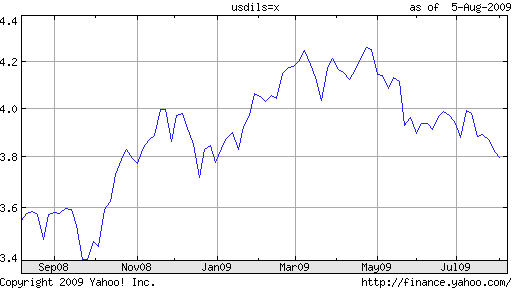
Over the last year, Israel has quietly amassed one of the world’s largest repositories of foreign exchange reserves. On average, the Central Bank of Israel has purchased $100 million worth of Dollars every day since July 2008, bringing its total reserves to $52 Billion. The Bank’s goals are twofold: to sterilize the inflow of speculative money pouring into Israel in order to mitigate inflation, and to stem the appreciation of the Shekel.

Towards this latter, the Bank received a boost by the credit crisis, which caused an outbreak of risk aversion and sent investors rushing to shift funds into so-called safe haven countries/currencies. As a result, the Israeli stock market tanked, and the Shekel plummeted 30% in a matter of months.

shekel-dollar

Thanks to the recent upswing in risk appetite, however, the Shekel has bounced back, having risen 10% since April. While the Shekel still remains well off its its 2008 highs, the sudden rise still elicited the attention of the Bank of Israel, which announced that it would respond to the, “Unusual movements in the exchange rate that are inconsistent with underlying economic conditions, or when conditions in the foreign exchange market are disorderly,” by intervening heavily in the open market. It“is believed to have purchased between $1.5-1.7 billion this week so far.”

The Bank has also taken steps to inadvertently degrade its currency by lowering its benchmark interest rate to .5%, and buying bonds on the open market. “The central bank will have bought a total of 18 billion shekels ($4.7 billion) of bonds when it completes the program….The bank said in its statement that it does not intend to sell the securities it purchased and will continue buying foreign currency.” While its unclear whether the program has succeeded in stimulating the economy - whichcontracted by 3.7% last quarter - it has provoked inflation, which is still running in excess of 3% per year.

The forex markets have taken notice of both developments, sending the Shekel down 4% since Monday. Still, it’s not clear whether the Bank of Israel has any real credibility with traders. By its own admission, its intervention program is temporary: “It is clear that we won’t carry on buying foreign currency forever. Everybody understands that the central bank can’t beat the market, but sometimes the market does things that are not justified.”

Analysts, meanwhile, insist that the Shekel’s appreciation is not unusual, and that the intervention runs counter to fundamentals. “[The] market pressures strengthening the shekel against the dollar, are, in fact, consistent with underlying economic conditions. Fundamental economic conditions favoring the revaluation of the shekel include the accumulation of a balance of payments credit of $4.3 billion over the past thee quarters.” These analysts, then, are more concerned about rising inflation then about the competitiveness of Israeli exports.

Barclays, an investment bank, evidently subscribes to this school of though, and predicts the Shekel “will increase 2% after breaching their so-called resistance levels.” Merrill Lynch, meanwhile, sees the Shekel appreciating an additional 10% over the next year.

The US Housing Market and the Dollar

As reported today by the Mortgage Calculator and other sources, the US housing market could be in the early stages of recovery. “Nationwide, home resales in June are up 9 percent from January, on a seasonally adjusted basis. Sales of new homes have climbed 17 percent during the same period. And construction, while still anemic, has risen almost 20 percent since the beginning of the year. Even home prices, down one third from the top, edged up in May, the first monthly increase since June 2006.” While the data is certainly susceptible to overly optimistic interpretation, these represent positive developments by any standard.

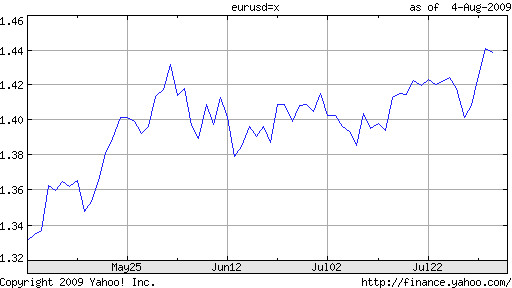
Before I lose the forex traders out there who probably think that they logged on to a housing blog by mistake, I’d like to point out that the release of this data coincided with a marked decline in the value of the Dollar, which “hovered near its 2009 lowagainst the euro on Tuesday as a surprisingly strong U.S. housing report suggested the recession was waning.” This sound-byte encapsulates two important relationships: between forex and housing, and between housing and the economy. The former is indirect, while the latter represents a direct connection.

dollar-euro

In a vacuum, forex traders probably couldn’t care less about housing data. Between interest rates, economic performance, geopolitics, risk appetite, financial markets, there is enough fodder to overwhelm most amateur analysts. Housing, then, is only important insofar as it bears on one of these “primary” forex factors. However, given the increasing role of housing in the US economy, perhaps it should itself be elevated to the top tier.

Let me explain: when the positive housing data was released last week, financial markets rallied, led by a “4.5% leap in the Dow Jones U.S. Home Construction Total Stock Market Index.” This immediately carried over into forex markets, as investors sold the Dollar en masse. “The market was desperate looking for direction, and a number like this is giving the market a small lift,” offered one analyst.

“The dollar remains vulnerable to good economic news,” summarized another. At face value, it might seem somewhat ironic that the Dollar is now inversely related to US economic performance. From the collective standpoint of investors, the US economic recovery is simultaneously indicative of and less interesting than a global recovery, and an improved environment for risk-taking. This tends to manifest itself in the form of a shift of funds away from safe-haven currencies is riskiery alternatives. In short, pay attention to the US housing market (data); the Dollar hangs in the balance.

Use Forex Demo To Trading (Tips in Trading Currency)

  • Tip 1. Gamblers go to casino. All unproved, spontaneous actions in Forex trading — are a part of pure gambling.Any attempt to trade without analysis and studying the market is equal to a game. Game is fun except when you are losing real money...
  • Tip 2. Never invest money into a real Forex account until you practice on a Forex Demo account! Allow at least 2 month for demo trading. Consider this: 90% of beginners fail to succeed in the real moneymarket only because of lack of knowledge, practice and discipline. Those remaining 10% of successful traders had been sharpening and shaping their skills on demo accounts for years before entering the real market.A good demo account to start practicing with could be.
  • Tip 3. Go with the trend! Trend is your friend. Trade with the trend to maximize your chances to succeed. Trading against the trend won't "kill" a trader, but will definitely require more attention, nerves and sharp skills to rich trading goals.
  • Tip 4. Always take a look at the time frame bigger than the one you've chosen to trade in. It gives the bigger picture of market price movements and so helps to clearly define the trend. For example, when trading in 15 minute time frame, take a look at 1 hour chart; trading hourly would require obtaining a picture of daily, weekly price movements.
  • If a trend is hard to spot — choose a bigger time frame. Up and downmarket patterns are always present. Always make sure you know the dominant trend, unless you are a scalper. Scalpers have no need to spend their time studying big trends, what's happening in the market here and now (during 5-10 minute time frame) should be of only importance to a Forex scalper.
  • Tip 5. Never risk more than 2-3% of the total trading account. One important difference between a successful and an unsuccessful trader is that the first is able to survive under unfavorable conditions on the market, while an unsuccessful trader will blow up his account after 5-10 unprofitable trades in the row.
  • Even with the same trading system 2 traders can get opposite results in the long run. The difference will be again in money managementapproach. To introduce you to money management, let's get one fact: losing 50% of total account requires making 100% return from the rest of money just to restore the original balance.
  • Tip 6. Put emotions down. Trade calm. Don't try to revenge after losing the trade. Don't be greedy by adding lots of positions when winning.Overreaction blocks clear thinking and as a result will cost you money. Overtrading can shake your money management and dramatically increase trading risks.
  • Tip 7. Choose the time frame that is right for you. Choosing wise means that you are comfortable and have time enough to analyze the market, place and close orders etc. Some people can't wait for hours for the price to make a move, they like action and therefore prefer smaller time frames. On the contrary, for others 10-15 minutes is a hustle to be able to make the right decision.Tip 8. Not trading or standing aside is a position. When in doubt — stay out. If it is not clear where the market will move — don't trade. In this case saving present capital is and absolutely better choice than risking and losing money.
  • Tip 9. Learn to use protective stops. Respect them and don't move.Hoping that market will turn in your direction is a very delusive hope. By moving a stop loss further a trader increases his chances to end up with much bigger loss.
  • When holding to a losing trade too long, and even if funds permit, tradersas a rule are very reluctant to accept big losses, thus often continue "hoping for best". In the mean time invested money is stuck in the open trade for unknown period of time (weeks and even months) and cannot be used for opening new positions. Not working money — dead money. Also this will result in constant interest payments for holding open positions.
  • Tip 10. "Keep it simple, stupid" — applies to indicators, signals and trading strategies.Too much information will create a controversial picture of where to trade and when not to. To avoid lots of confusion create a simple but working method of trading Forex.
  • Tip 11. Think about risk/reward ratio before entering each trade.How much money can you lose in this trade? How much can you gain? Now, make a decision if the trade is worth entering.Example: if trader is looking for possible 35 pips gain and possible 25 pips of loss, such conditions are not worth trading. Compare it with the situation when a trader has 100-120 pips of potential gain and only 10-20 pips of possible loss. This is the trade to open!
  • Tip 12. Never add positions to a losing trade. Do add positions when the trade has proven to be profitable.Don't allow a couple of losing trades in a row become a snowball of losing trades. When it is obviously not a good day, turn the monitor off. Often not trading for one day can help to break a chain of consecutive losses. Trying to get revenge can often make things worse.
  • Tip 13. Let your profits run.Let your position be open for as long as the market wishes to reward you. Of course, for this traders need a good exit strategy, otherwise they risk to give all profits back... Running two or more open trades gives an option to close some positions earlier and keep others running for higher profits.
  • Tip 14. Cut your losses short.It's better to finish unprofitable trade quickly than wait for the situation to get worse. Don't put a stop loss too far — it's your money you risk. Better calculate the best spot to enter when a potential loss would be minimized. Again: respect your stop and don't move it "cherishing hopes".
  • Tip 15. Trade currency pairs in respect to their active market hours. Learn about overlapping market hours: when two markets are open and highest volume of trades is conducted. For example, Australian and Japanese trading sessions are overlapped from 8pm to 1 am EST. At that time trader can successfully trade AUD/JPY currency pair.
  • Tip 16. Choose the right day to trade. This recomendation is often wrongly taken as an optional thing, because everyone knows that Forex market is open 24 hours a day 7 days a week. Yet, choosing the time to trade can make a difference between successful and hopeless trading.
  • It's proved and highly recommended not to trade on Mondays, when the market has recently awaken and is making first "probation steps" to form a new or confirm a current trend; and on Fridays afternoon, during the huge volume of closing trades. The best days to trade are Tuesdays, Wednesdays and Thursdays.
  • Tip 17. Learn about Fibonacci levels and how to use them for trading. Fibonacci can be very helpful in trading, even partially using the study, for example, to determine the best exit, can bring traders to a new edge of trading.
  • Tip 18. Always ensure that a signaling bar/candle on the chart is fully formed and closed before you enter a trade. A golden rule of trading: "Always trade what you see, not what you would like to see" is the best explanation here.
  • Tip 19. If you ask for someone else's advice as about how and when to tradein other words, choose to rely on live trading signals from other traders, make sure you do it for your benefit, not for disaster. If you use such signals to discover how other traders do analysis and study on the price — you are on the right track and soon you'll be able to do analysis yourself.But if you're just blindly following recommendations and your only task is to push the correct button... think again.
  • Tip 20. Using a highly leveraged account comes at a cost. It will, of course, give a trader more financial gear to trade, and also trader's broker will be happy as it will mean higher spread income for him. On the other side a trader signs up for additional risks that multiply with higher leverage in a "friendly tight" proportion.
  • Tip 21. Learn to measure trading success by the end of the day, week and then month and year. Do not judge about your trading success on a single trade. To be successful traders don't need to win every trade, they also don't become rich in one trade — they need to be profitable in a long run.
  • Tip 22. There is no such thing as a secret approach to understanding the market. Take the time to develop a solid trading system and find out that the secret to trading success lies in hard work and constant learning.source: forex tips

4 Reasons to Practice on Small-Size Real Account before Risking Big on Forex

Practicing on the demo accounts before moving on to the real money trading is an obvious requirement for successful participating on the Forexmarket. It’s always better to lose virtual money while you are learning new market theories, developing your trading system or improving your practical Forex skills. But is it right to jump from the virtual account to a big real money one when you suddenly realize that you manage to be profitable for a long period of time in your demo trading? Here are some reasons to move on to just a small real account before risking a lot of hard-earned money on Forex:
Real trading is different from virtual, because you get real emotions when you lose or earn money. Trading with $100 on real will get you more real feeling than trading with $10,000 on demo. It’s better to lose $50-$100 to learn controlling those emotions than several thousands dollars.Know your broker’s real account servers’ behavior. With some brokers virtual trading is smooth and fast, while real account bring unpleasant surprises with order delays, requites, refusals, slippage and stop-hunting. Trading with a small real account can save you big money if you are unlucky to stumble upon a bad broker.Know your broker’s funds handling practice. Don’t risk depositing thousands dollars before trying small deposits to see how smooth transfers go with this broker. Pay attention to user support if you encounter some problems with the depositing or withdrawing your money. If your broker doesn’t take seriously small money deposits/withdrawals than you should be careful with it, since it may treat big amounts the money in the same way.Practicing on small real account has another advantage before thedemo trading – you get the real rewards when you trade right and you get real losses when you do something wrong. This way you’ll quickly learn to do everything right and won’t be doing the same mistakes again and again.
Demo trading is one of the greatest tools to learn Forex trading, just don’t forget that nothing will teach you better than trading on a real account. But why risk big before being confident in your skills, when you can start with a small-size real account?

Saturday, August 8, 2009

Commodity Investing Maximazing Returns Through Fundamental Analysis (Ebook)

Commodity Investing Maximazing Returns Through Fundamental AnalysisStraightforward and accessible, Commodity Investing balances academic-quality analysis with clear, compelling prose, and provides those interested in this fast-growing field with unparalleled investment insights. Page by page, you’ll acquire a deeper understanding of this discipline and discover how to make more informed decisions when investing in such a dynamic environment. With this book as your guide, you’ll benefit from the lessons of experienced practitioners and quickly come to grips with what it takes to make it in today’s commodity market. From the Inside Flap While commodities have been around for a long time, investors are just starting to realize their potential. But in order to achieve success in tomorrow's commodities market, you need skills and knowledge that are in short supply today. That's why Adam Dunsby and his colleagues at Cornerstone Quantitative Investment Group (CQIG)—a leading commodity trading advisor—have created Commodity Investing. Rooted in theory, but proven in practice, this detailed guide will give you the tools you need to succeed in this challenging market. Opening with a clear assessment of past commodity performance, this reliable resource puts commodity futures investing in perspective and prepares you for what should be expected along the way. With this information in hand, you'll be introduced to the commodities themselves and discover the state of their industries as well as their long-term outlook. Along with these big picture issues, you'll also become familiar with the nuts and bolts of numerous commodities—from oil, corn, and cattle to copper, coffee, and cotton—and learn how to effectively integrate them into your portfolio. Based onor variables, the shape of the futures curve, and risk control methodologies such as value-at-risk and maximum drawdown. Page by page, you'll acquire a deeper understanding of this discipline, which will allow you to analyze specific commodities and strategies according to their individual characteristics and make more informed decisions when investing in this arena. Straightforward and accessible, Commodity Investing balances academic-quality analysis with clear, compelling prose, and provides those interested in this fast-growing field with unparalleled investment insights. With this book as your guide, you'll benefit from the lessons of experienced practitioners and quickly come to grips with what it takes to make it in today's commodity market. the hard-won experiences of authors Adam Dunsby, John Eckstein, Jess Gaspar, and Sarah Mulholland, Commodity Investing explains the various components that may prove useful in either constructing an investment strategy or in evaluating a commodity-based investment strategy. It also provides important insights on trend following strategies, anch

Download Here